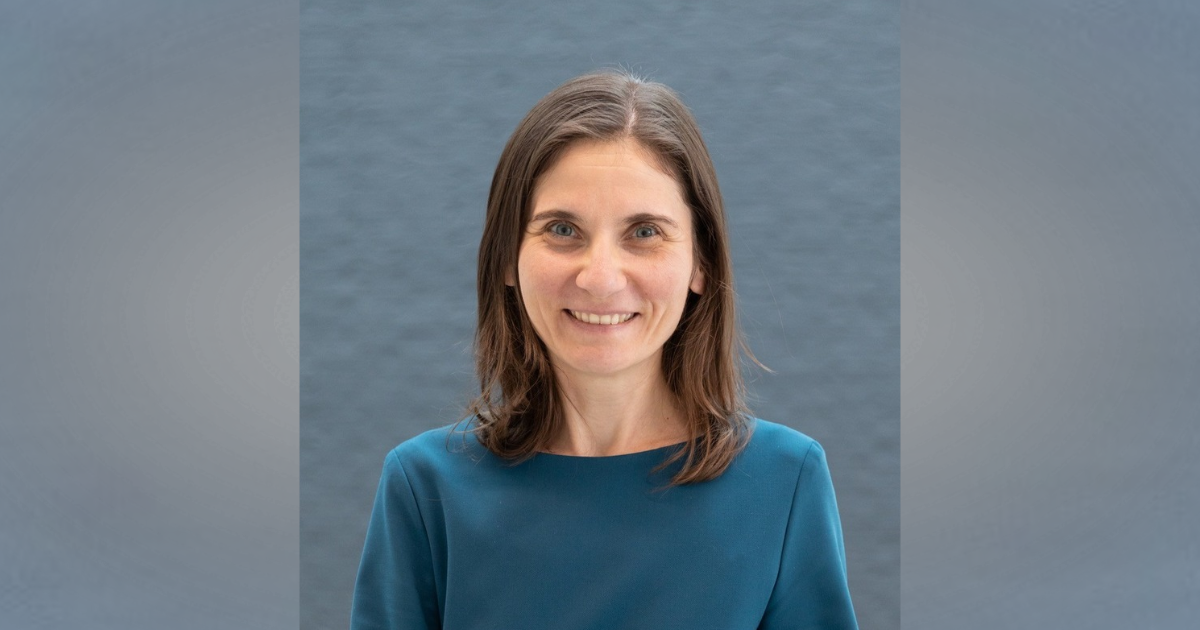
Dr Carina Popovici
For as long as there has been an art market, there has been the question of whether a work is what it claims to be. Art Recognition was built to bring a new kind of evidence to that question. Founded by Dr Carina Popovici, a former theoretical physicist and quantitative risk specialist, the company uses artificial intelligence to compare a work against an artist’s entire authenticated oeuvre, adding a systematic, reproducible layer alongside connoisseurship, provenance research and scientific analysis.
For this edition of The Interview, we sit down with Carina, CEO and co-founder of Art Recognition, to discuss what first led her to question how authenticity is determined, how the technology works in practice, and what collectors, estates and their advisers should be doing now to protect the integrity of the works in their care.
Your career began in theoretical physics and quantitative risk before you founded Art Recognition. What first led you to question the way authenticity is determined in the art world, and what did you see that traditional approaches might be missing?
What first led me to question it was a forgery scandal in Germany. Wolfgang Beltracchi was a forger who, for more than twenty years, sold fake paintings through auction houses to collectors and museums, and leading experts accepted them as authentic. He was eventually caught by a single error. A painting sold as a 1914 work by the German artist Heinrich Campendonk contained titanium white, a pigment not in use at that time. Beltracchi believed he was using zinc white, which was period-appropriate, but what he had not realised was that the zinc white he used contained traces of titanium. The manufacturer had not disclosed it.
The case revealed two things to me about attribution. The first is that the expert eye, however experienced, can be fooled for decades. The second is that what finally exposed the forger was not a system but an accident, an undeclared trace in a tube of paint.
This made me question how much of attribution rests on individual judgment, and whether a complex problem like this could be addressed with a technical solution, a program that analyses a work systematically and reproducibly. As a physicist, I asked whether such a program already existed. In 2019 there was none, so I decided to build one.
What I think traditional approaches can miss is not expertise but scale and consistency. Connoisseurship, provenance and forensic analysis are powerful, but each leaves gaps the others cannot fill. Experts disagree, provenance is missing, and forensics rarely attributes a work to an artist. What was missing was a systematic comparison of a work against an artist's entire body of work. It is a fourth layer alongside the existing methods, not a replacement, and it is built from the scholarship of the other three.
Art Recognition uses AI to identify patterns in an artist's work that may not be apparent even to experienced specialists. Can you explain how the technology works in practice, and share an example of an artwork where its findings challenged or changed an established understanding of attribution?
For each artist we train a dedicated model on the authenticated works, usually taken from the most accepted catalogue raisonné, and on a carefully chosen set of works that are not by the artist, such as imitations and works by followers. We train on different architectures, namely convolutional neural networks and Vision Transformers, and we are now working on a multimodal model that adds text and art-historical knowledge to the visual input. Once a model has been tested, it compares a new work with everything it has learned about the artist. The result is a probabilistic answer, a measure of how consistent the work is with that artist's characteristics.
An example is a case involving Ernst Ludwig Kirchner, a central figure of German Expressionism who is particularly well known in our region, because he spent the last two decades of his life in Davos, in Switzerland. His painting Katze in Blumenwiese came directly from his estate and carried the estate stamp, but for decades it was attributed to a lesser-known Swiss painter, Albert Müller. Specialists later rejected that attribution, and a symposium of leading Kirchner experts in 2008 largely favoured Kirchner. Even so, the Kirchner Archive, the authority whose acceptance the market requires, had not issued its opinion, and the painting remained stranded for years. We analysed it in 2022 and our model returned a 97.3 per cent probability in favour of Kirchner's authorship. That evidence allowed the Archive to accept the painting, and it issued a certificate confirming the work as authentic. The painting was shown again at Art Karlsruhe in February 2026 and can now enter the market under Kirchner's name.
The art market has traditionally relied on connoisseurs, scholars and catalogue raisonné committees to determine authenticity. What happens when an AI assessment contradicts an established expert opinion? And how should collectors, institutions and their advisers navigate competing forms of evidence?
Our first assumption in such a case should not be that the expert is right and the machine is wrong. We regularly see paintings that several experts have assessed and on which they reached different conclusions. In that situation an AI result will necessarily differ from at least one of them. The difference often says more about the expert process than about the technology. We do not tune our models toward a desired outcome, and we do not factor expert opinion into the analysis. What matters is that the model is well trained and the probabilities are reliable and documented.
Authentication has traditionally rested on three pillars: connoisseurship, provenance research and scientific analysis. Each is powerful, and each has limits. AI-based analysis is the natural expansion toward a fourth pillar, a fourth layer of evidence, which complements the other three and is built on them, since our models are trained on the knowledge they produce. Every artwork comes with a different set of evidence. For one, the provenance may be strong and the experts divided. For another, the material analysis may be conclusive and the documentation thin. So there is no single formula. It is for the parties to a sale or purchase to weigh the evidence available for the particular work, carry out their due diligence, and reach their own conclusion. The final decision always belongs to the owner, the buyer or the auction house, together with their advisers.
From increasingly sophisticated forgeries to incomplete provenance and contested attributions, where do you see the greatest vulnerabilities in today's art market? Do you think AI-assisted authentication will become a standard part of due diligence when acquiring or managing significant collections?
The greatest vulnerability, in my view, is the market’s reliance on reputation and narrative in place of independent evidence. Fraud today is often less about a single forged document and more about the construction of an apparently credible story around a work, and AI now makes it possible to fabricate entire dossiers, with immaculate provenance. The risk is highest where scrutiny is lowest, in private sales, estate dispersals and cross-border transactions, and wherever an institution’s name is treated as a guarantee, which can delay scrutiny until the moment of resale. There is also a large group of works that are simply stranded, because experts disagree, provenance is incomplete, or the authority that should decide declines to give an opinion.
I do believe AI-assisted authentication will become a standard part of due diligence, alongside connoisseurship, provenance research and scientific analysis. It adds a layer of evidence that is consistent, documented and independent of the interests of the parties. It is also practical: it needs only a photograph, and it can be done discreetly, without creating friction between a collector and a gallery. I would present this as the direction of the field and our goal, not as something already established. No single method is universally accepted today, and the weight given to each piece of evidence will always depend on the work and the transaction.
Authenticity is not simply a question of financial value; it is also fundamental to an artist's legacy and how their work enters art history. What role might AI play in helping artists, estates and collectors safeguard that legacy, and what practical steps should they be taking today?
For me, authenticity is about honoring an artist’s legacy and making sure what they left us is faithfully represented. A forgery is a distortion of history, because false works enter exhibitions and archives and rewrite the record of human creativity. AI can also help to protect that legacy. It gives estates, archives and collectors an independent, documented assessment of whether a work is consistent with an artist’s body of work. As the Kirchner case shows, it can also help in the opposite situation, where a genuine work is left in a state of uncertainty without a secure author and risks being lost to the artist’s legacy.
As for practical steps, the most important is to make sure that all the records relating to a work are kept together and kept up to date: its provenance, its conservation and restoration history, any forensic or scientific analyses, and any other relevant documentation, including independent analyses such as AI-based ones. A complete and well-organised file makes it far easier to answer questions about a work when they arise, and it protects the work’s place in the artist’s history.
Art Recognition has helped develop a framework for the responsible use of AI in art authentication. As these technologies become more widely adopted, what standards of transparency, accountability and independent scrutiny do you think are essential for their findings to be trusted, including in legal disputes?
In a field where reputations, markets and legal outcomes are at stake, providers should be able to explain how their models are built, what data they learn from and how reliable their results are, in language that non-specialists can understand and question. That openness should be backed by outside review, through peer-reviewed publication and academic collaboration, so that the methods can be challenged by others and not simply taken on trust. It also means being honest about what the output is: a probabilistic assessment that is traceable and reproducible, to be weighed with the other evidence. And it requires independence, which is why our fee does not depend on the artist or the outcome, and we decline any form of sales commission.
In a legal dispute, a court or an adviser should therefore expect disclosure of how the model was trained, where its data comes from and what its known error rates are, so that the finding can be properly understood, tested and weighed alongside the other evidence in the case.
You can find out more about Art Recognition at art-recognition.com