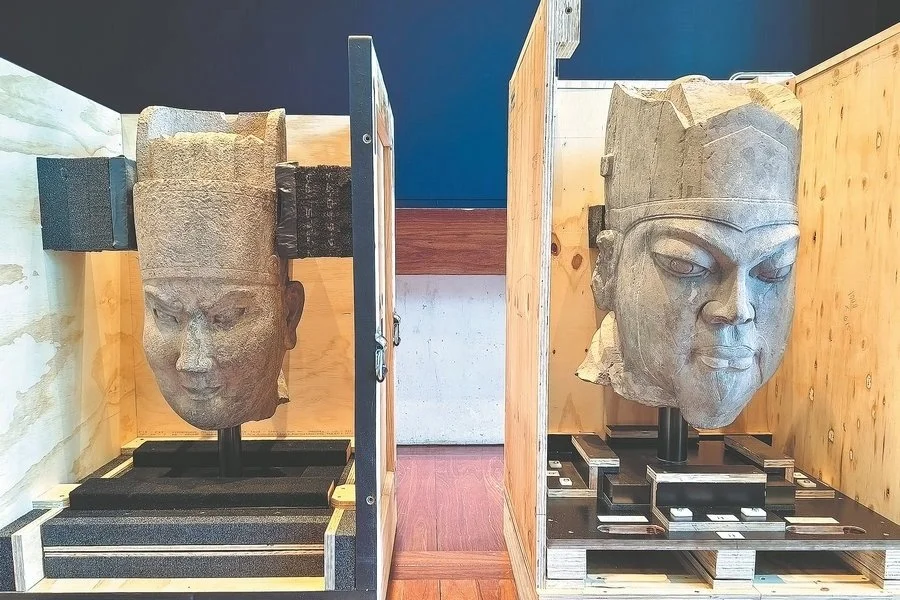
The two Northern Song dynasty (960-1127) statue heads that Australia returned to China. Photo: National Cultural Heritage Administration via Global Times,
A chance observation by National Gallery of Australia volunteer guide Janet Smith helped reopen the history of two limestone heads in the Gallery’s collection. After encountering a book about sculptures from the Northern Song dynasty’s imperial mausoleums in Henan, China, Smith recognised similarities between the published figures and the Gallery’s heads of a civil and a military official. The works had entered the national collection in 1995 through a private donation. Following further provenance research and a formal request from China in 2025, the Gallery handed the heads over in Canberra on 28 October 2026.
The objects themselves had not changed. What changed was the evidence available to understand where they came from, and how they came to Australia.
How provenance develops
Provenance is not a certificate completed at acquisition. It is an evolving account of an object’s ownership, custody and movement, assembled from records that may be incomplete or inconsistent. Newly digitised archives, historical photographs, scholarship and information from source communities can fill gaps or call accepted narratives into question. In the NGA case, a fresh connection between objects and their original setting prompted closer scrutiny of an earlier history that was not fully documented. For owners and institutions, the lesson is to preserve the distinction between what is established, what is inferred and what remains unknown.
Provenance is not authenticity
The terms are related, but they answer different questions. Authenticity concerns whether an object is what it is represented to be, including its maker, date or origin. Provenance concerns its history of ownership and custody, including the circumstances in which it changed hands. A work may be authentic yet have significant gaps in its provenance; a convincing attribution is not proof that its transfer or export was lawful.
What new information means for an owner
New evidence calls for investigation, not an automatic conclusion. A collector or museum should first establish what the material actually demonstrates, assess its reliability, identify any gaps and preserve relevant records. Depending on the circumstances, questions may arise about title, export or import restrictions, contractual representations, limitation periods or competing claims. The legal position must be assessed separately from ethical responsibilities and the possibility of voluntary restitution: a provenance concern does not, by itself, establish a legal obligation to return an object. Early advice from provenance researchers, legal advisers and, where appropriate, relevant communities or authorities can help determine a proportionate response.
Practical takeaways
Retain acquisition documentation, including invoices, sale agreements, correspondence, photographs, export records and research notes.
Maintain a dated, accessible provenance record for each artwork, with supporting sources and subsequent updates.
Identify uncertainties clearly: do not allow assumptions or unverified statements to become accepted facts through repetition.
Revisit provenance when new evidence emerges and at key moments, including acquisitions, loans, sales, gifts and succession planning.
This article is general information only and does not constitute legal or financial advice.