The Interview with Sarah Wei
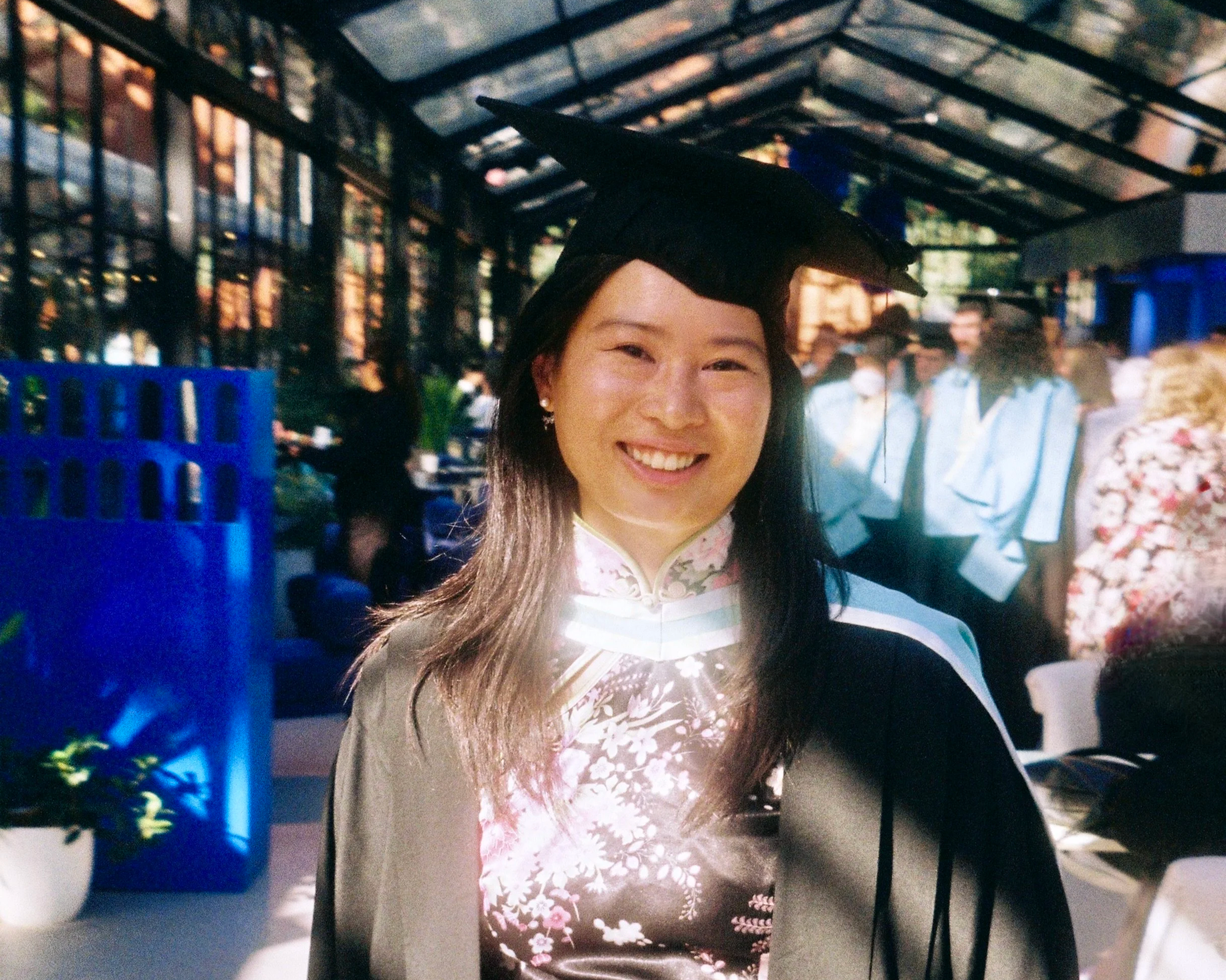
Portrait of Sarah Wei. Courtesy of Sarah Wei.
For this edition of The Interview, we turn the spotlight inward to one of our own, Lawyer Sarah Wei.
Sarah recently joined Aurelian Lawyers & Advisers after completing her Juris Doctor at Monash University and being admitted to practice in the Supreme Court of Victoria. Bringing together legal training, international arts experience and a thoughtful practice as a writer on art and culture, Sarah’s perspective reflects the intersection at the heart of Aurelian’s work: art, creativity, luxury and the law.
Having worked across the arts in Hong Kong and written for platforms including Ocula Magazine, Art Papers, Jing Daily and VICE, Sarah brings a particularly global and culturally attuned lens to legal practice. We are delighted to welcome Sarah to the team and to learn more about the experiences that have shaped her path into art and luxury law.
Welcome Sarah. You’ve recently completed your JD at Monash University and been admitted to practise in the Supreme Court of Victoria. What first drew you to law, and how did that path lead you to Aurelian?
I am a writer, or so I call myself, and in that way, it has become my craft. The law felt like a natural progression. Both require close reading, careful language, and an ability to understand how ideas, people, and systems interact.
I finished studies for my bachelor's in economics and finance at The University of Adelaide in 2017, seemingly very different from the media and art world I fell into after graduation. After years of engaging with the arts through writing, programming and cultural work, law offered a different way to support the creative industries. It was through my work in Asia that the idea of becoming an advocate for the writers, artists, creatives, photographers and the like, my friends really, became more and more appealing.
Aurelian felt like the right place to bring those lines of practice together. The firm sits exactly at the intersection I care about— art, luxury, international law, and the structures that help cultural value move.
Before joining Aurelian, you had already built a strong connection with the arts, including through your work in Hong Kong. Can you tell us a little about your experiences there and how they shaped your understanding of the art world?
Hong Kong was a formative place for me professionally. I worked across arts programming, global editorial projects, and cultural communications in luxury travel and media, including with Asia Society Hong Kong, Art Central, The Upper House, and LUXE City Guides. I was lucky enough to cover stories, interview, and work with people from around the world, as cheesy as it sounds. Whether that be artists, curators, collectors, editors, brand teams, cultural institutions or public audiences. I think understanding the cultural, language or artistic context of the work you engage with is invaluable to understanding why or how the art world operates.
You have also written extensively on art and culture, particularly in relation to Hong Kong’s contemporary art scene. How has writing about art informed the way you observe artists, institutions, collectors and markets?
When you write about an artist, an exhibition or a market development, you have to look at the why or why now of the story. That discipline is very useful in legal practice too. It encourages a more considered way of looking at facts, relationships or risks that a client might face.
For example, now that AI is the hot topic of the moment. I can see how issues arise from different perspectives. Collectors may need to understand the copyright risks involved in reproducing or digitising artworks they own. Artists may need guidance on how their works can be protected, licensed or controlled in digital contexts. Institutions, meanwhile, may want to digitise archives or use AI to make collections easily searchable.
Aurelian works across art, luxury, intellectual property, technology and commercial law. What attracted you to this kind of specialised legal practice, as opposed to a more traditional legal pathway?
A specialised practice like Aurelian allows me to work with clients whose assets, projects and businesses are often deeply personal, creative or reputation-driven. That makes the work more varied and, to me, more interesting.
Do you think your background as an arts, culture, and travel writer gives you a different perspective as a lawyer?
Yes, as a writer you are expected to tell stories in an understandable way, and often easily digestible for all sorts of audiences. I believe the same practice can be said for lawyers. When you encounter creatives who have never dealt with lawyers or the legal system before, it can be daunting. After being on both sides, I am able to come at problems with an understanding of the thoughts or questions a creative might have.
Much of your writing engages with context: place, identity, cultural memory, institutions and market dynamics. Are there particular legal issues in the art world that you now find yourself especially drawn to?
I am particularly drawn to copyright because it sits so closely to the creative process itself. In 2021, I co-founded Paradigm Haus, a print magazine, and as an independent publisher we regularly had to think about questions of authorship, ownership, permission, and creative control. Those questions are central to how artists, writers, photographers and designers make and share their work. Intellectual Property rights are also often misunderstood, particularly in the art world, where ownership of a physical object does not necessarily mean ownership of the rights attached to it.
The art and luxury sectors are increasingly shaped by digital platforms, global collecting, brand collaborations, AI and questions of authenticity. What do you see as some of the most interesting legal challenges emerging in this space?
One of the most interesting challenges is AI training and reproduction, particularly because Australia and other jurisdictions are not all taking the same approach. For instance, recent Studio Ghibli-style AI images show how quickly distinctive creative styles can be reproduced, circulated and commercialised online. The legal challenge is to understand where copyright, moral rights, trade mark law, contract law, passing off or consumer law may offer protection.
Finally, what advice would you give to law graduates or young lawyers who are interested in building a career at the intersection of law, art and culture?
Beyond your studies, go to exhibitions, read widely, and follow the artists or institutions you believe in. The base line is to know the industry you hope to practice in, who’s doing what, where is the art (or law) developing, and how cultural value is created, exchanged, and protected.