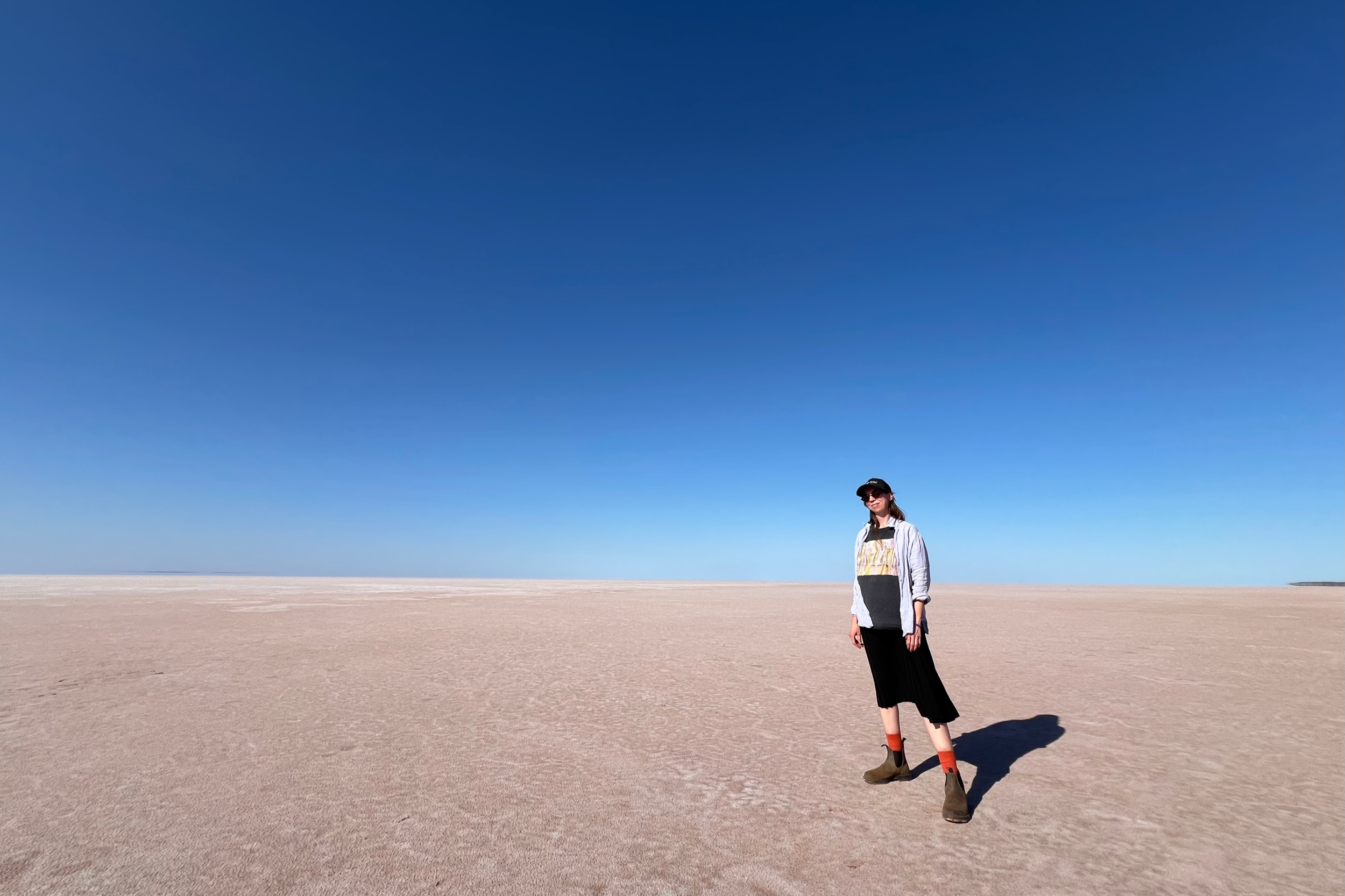
Gretel Bull at the site Wilkinkarra (Lake Mckay), an expansive salt lake and important sacred site straddling the border between the NT and WA. Image Courtesy of Gretel Bull.
For more than fifty years, Papunya Tula Artists has made its mark as one of the foremost advocates and proprietors of First Nations Art in Australia. What began in 1971 as an act of cultural and artistic agency has grown into one of Australia's most significant art enterprises, entirely self-sufficient, and inseparable from the communities it serves across the Western Desert. Yet with global recognition has come new complexity, questions of provenance, cultural protocol, and the ethical stewardship of works that carry knowledge far beyond their surface.
For this edition of The Interview, we sit down with Gretel Bull, Business Manager at Papunya Tula Artists, to discuss the centre's unique business model, cultural stewardship, and what still needs to change to properly protect First Nations artists and their intellectual property.
Papunya Tula Artists (PTA) has been operating for more than 50 years. Could you give us a quick introduction on the background of the center, when exactly was it set up and for what purpose?
Papunya Tula Artists was established in 1971, and incorporated as a private company in 1972, one of the first Aboriginal-owned and governed art centres in Australia. The company was established by a core group of painters at the government settlement of Papunya as a means of having cultural, financial and artistic agency, and as a vehicle for self-determination. The company has continued to sustain a vast network of artists and their family members across the Western Desert since its inception. Papunya Tula Artists is unique in its entirely self-sufficient business model, receiving no external funding from government or philanthropic sources.
What considerations did PTA take into account when deciding whether to be set up as a private corporation rather than a non-profit? What are the benefits of doing so?
Papunya Tula Artists’ status as a private company gives us greater freedom to give back to the community, as directed by Papunya Tula’s board. In effect, the company operates as a hybrid between a for-profit and not-for-profit enterprise, contributing resources to various community needs such as funerals, ceremony and sorry business, and distributing food and fuel vouchers to those in need.
Funds raised through the sale of Papunya Tula paintings were instrumental to the establishment of The Purple House, the remote dialysis support service which now provides dialysis to people across twenty remote communities.
How do you approach works that contain culturally sensitive stories, imagery or knowledge?
This has been an ongoing process of cultural negotiation over the last 50 years. In the 1970s, the artists were less aware of the implications of selling their works – where they might end up and who they might be seen by. As a result, some of the early Papunya boards contain highly sensitive cultural imagery.
Over time, the artists developed methods of omitting and concealing cultural sacra in their works, to protect their culture, and for the safety of the viewer – sensitive imagery is also powerful, and potentially dangerous when viewed outside the correct cultural framework.
Today, we regularly undertake community consultations regarding potentially sensitive images, where they can be displayed and by who they can be seen. This is a living process, and sometimes works that were formerly considered ‘safe’ to display are later deemed to be restricted.
While, institutions and galleries are becoming increasingly proactive in terms of consultations around cultural restrictions, there is nothing restricting the private resale of sensitive works.
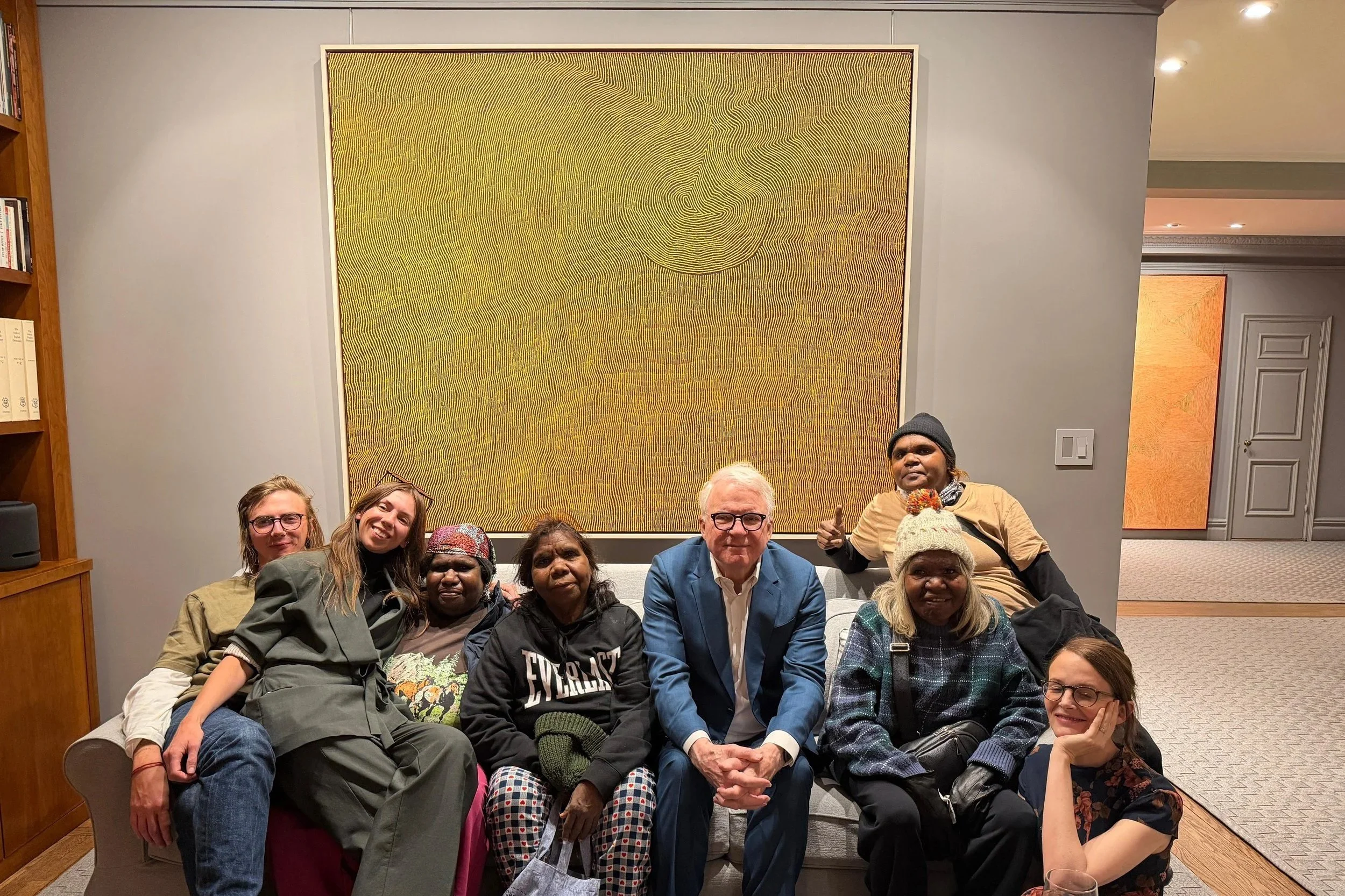
Photo from a trip to NYC in February where Gretel traveled with some of the Centre’s artists for three exhibitions of Papunya Tula Artists. Gretel and company are pictured at Steve Martin's apartment, who is a big collector of Papunya Tula artworks, and Australian First Nations art more broadly. Image Courtesy of Gretel Bull.
Pictured L-R: Jaxon Waterhouse, Gretel Bull, Yukultji Napangati, Marlene Nampitjinpa, Steve Martin, Mantua Nangala, Sally Rowe Nakamarra, Anne Springfield.
What should collectors consider when buying Indigenous art to make sure a work is authentic and has been ethically sourced?
Sadly, the Indigenous art market is rife with ‘carpet-baggers’ – private dealers who often exploit Indigenous artists for personal gain. I have heard many horror stories about these dealers – everything from paying people unfairly to paying artists in alcohol or drugs, to acts of intimidation and violence.
The best way to ensure you are purchasing Indigenous art ethically is by purchasing it through an Aboriginal-owned art centre. This ensures the proceeds go directly to the artist and support the communities in which they live and work. When purchasing art on the secondary market, be sure to request the artwork provenance. Again, provenance should come from the artists’ representative art centre by means of a certificate of authenticity. Be careful – many carpet baggers now issue certification of their own to confuse buyers, and buying an artwork without proper provenance can drastically affect the resale value of the work.
If you could change one part of Australia’s legal framework to better protect First Nations artists and their cultural and intellectual property, what would it be?
I would love to see some sort of national legislation that protects First Nations artists and their cultural heritage from the exploitation of private dealers. Art centres provide excellent models for ethical practice and artist advocacy, but a nationally standardised legislative framework protecting artists and their rights is long overdue.
You can find out more about Papunya Tula Artists at papunyatula.com.au
Aurelian note: First Nations artists may choose to create and sell their work independently, including directly to collectors. Purchasing directly from an artist can be a valid and ethical pathway, and artists may provide their own documentation and authentication. More broadly, ethical purchasing requires consideration of artist agency, fair and transparent dealing, provenance and appropriate documentation. The comments above reflect Papunya Tula Artists’ experience and its art-centre model.