Have you been caught out by AI slop?
Here are the global cases you need to know.
As AI takes hold of creative industries and the world at large, courts and policymakers globally are having to fast define how copyright law applies to AI-generated works. Recent decisions across the European Union, China, the United States, Australia and elsewhere reveal that copyright law still centres on human authorship, but it might not for long. If you use generative AI, don’t assume that the output will qualify for copyright protection, or that entering the prompt alone makes you the copyright owner.
Australia
In Australia, to date, no major copyright cases involving generative AI have yet been decided by the courts. However, existing principles of Australian copyright law strongly suggest that protection will continue to depend on human authorship and originality.
The Copyright Act (Cth) provides that protection is available only for works that are original and created by a person. In IceTV Pty Ltd v Nine Network Australia Pty Ltd (2009) 239 CLR 458 and Telstra Corp Ltd v Phone Directories Co Pty Ltd [2010] FCAFC 149, Australian courts confirmed that copyright protection requires independent human intellectual effort directed to the creation of the work itself.
As far as legislative reforms go, in October 2025, the Federal Government of Australia rejected calls from both the Productivity Commission and parts of the tech sector to introduce a copyright infringement exception for companies seeking to train their AI models on Australian copyright-protected works. The Attorney General added “Australian creatives are not only world class, but they are also the lifeblood of Australian culture, and we must ensure the right legal protections are in place.”
European Union
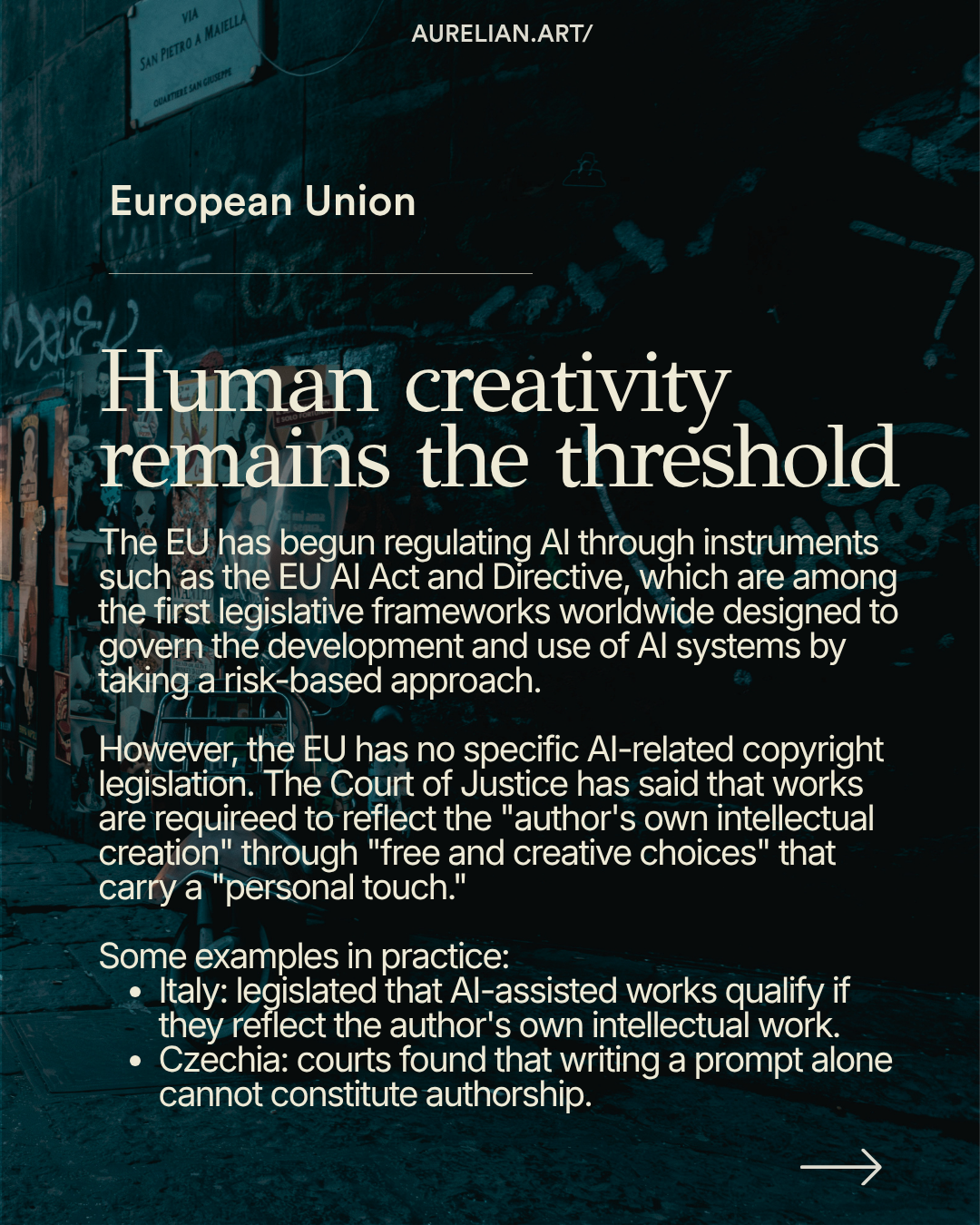
The EUhas begun regulating AI through instruments such as the EU AI Act and Directive, which are among the first comprehensive legislative frameworks worldwide designed to govern the development and use of AI systems by taking a risk based approach. The EU has no specific legislation addressing AI-generated works and copyright. However, the Court of Justice recently published an advisory opinion suggesting that copyright requires a work to reflect the "author's own intellectual creation" through "free and creative choices" that carry a "personal touch." In October 2025, Italy moved to resolve the issue domestically by legislating that copyright applies to works of human ingenuity created with AI tools, provided the result reflects the author's own intellectual work. Czechia's courts took a stricter view, finding that writing a prompt alone cannot constitute authorship.
China
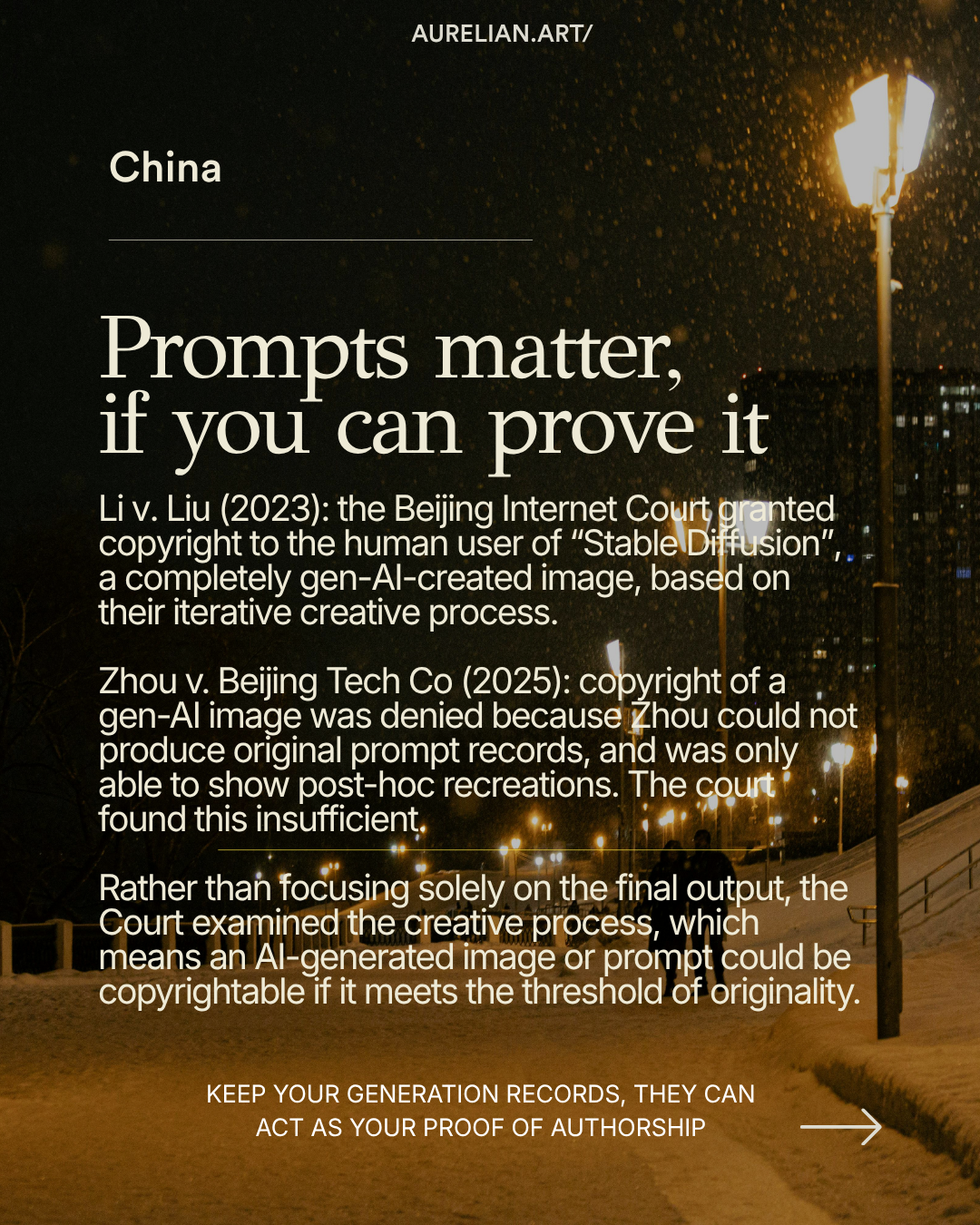
Chinese courts have addressed the issue of AI prompts directly. In 2025, at the Beijing Internet Court, a content creator named Zhou brought a claim against a Beijing tech company for using her AI-generated "Cat Crystal Diamond Pendant" image without permission. The court ruled against Zhou, not because AI-generated images can't be copyrighted, but because they failed to prove an original creative process behind the image, including original prompts or generation records. It was built on a similar case in 2023, in Li v. Liu the court granted copyright to the human user of ‘’Stable Diffusion” based on their iterative creative process: setting detailed prompts, adjusting parameters, and selecting from generated outputs. Rather than focusing solely on the final output, the Court examined the creative process, which means an AI-generated image or prompt could be copyrightable if it meets the threshold of originality.
United States
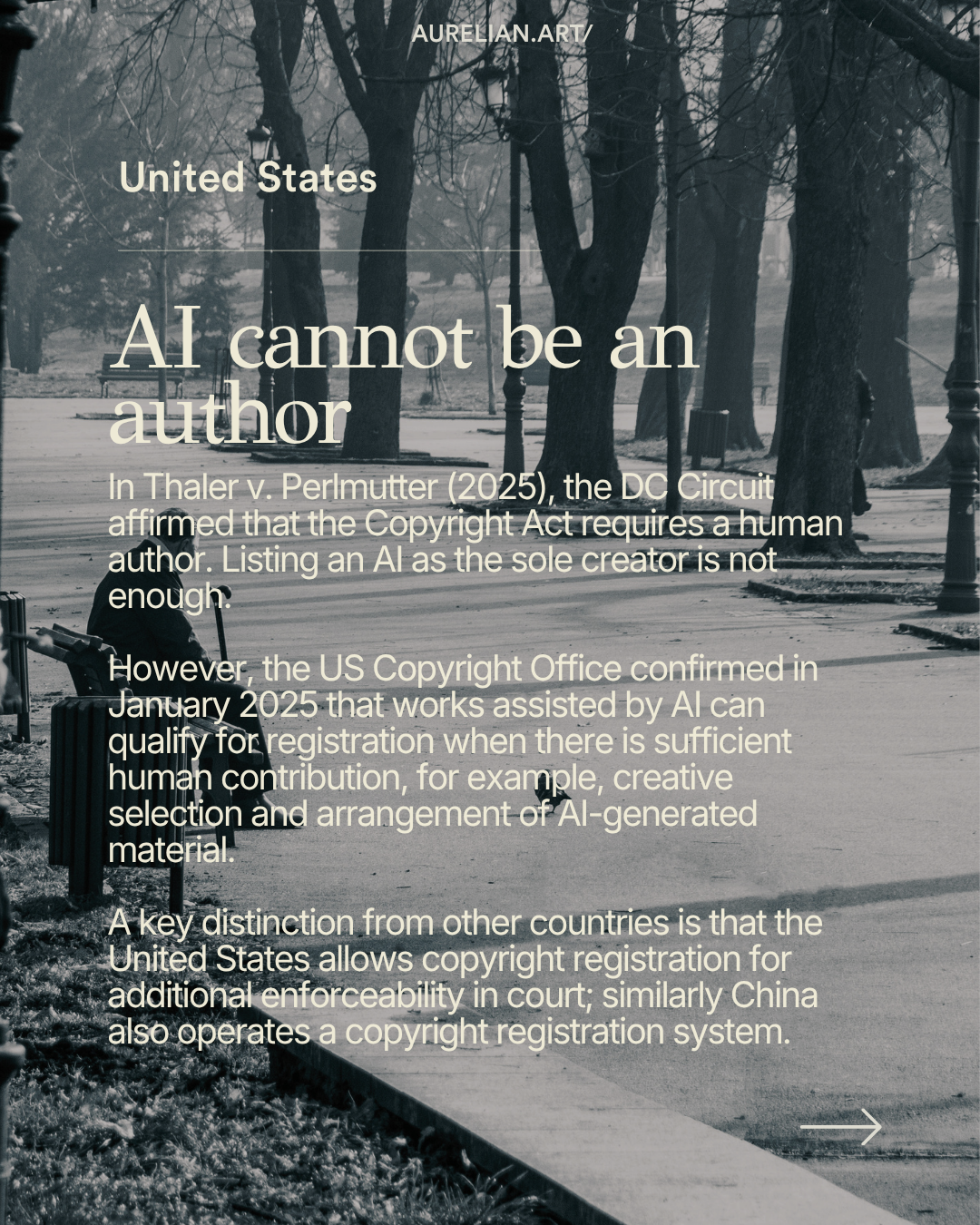
In the United States, the Court of Appeals for the District of Columbia affirmed copyright law does not protect works created fully by AI in Thaler v. Perlmutter. Dr. Stephen Thaler tried to register a copyright for an image titled ‘A Recent Entrance to Paradise’, which was generated by his AI system, the “Creativity Machine”. In his application to the U.S. Copyright Office, Thaler listed the machine as the sole “author.” The Office rejected the application, and Thaler challenged the decision in court. Writing for the unanimous panel, Judge Patricia Millett emphasised that “[a]uthors are at the center of the Copyright Act.” While the statute does not expressly define the term “author,” the court held that the Act’s structure and underlying assumptions support a human authorship requirement. For instance, provisions related to ownership, inheritance, and copyright duration are premised on characteristics unique to human authors, such as the capacity to own property. The Court noted that machines cannot legally sign documents, express intent, or satisfy the legal standards for joint authorship.
In recent developments, the U.S. Copyright Office’s January 2025 report confirms that works created with the assistance of generative AI can qualify for copyright registration if there is sufficient human contribution.
Aurelian Lawyers & Advisers works with families, collectors, and cultural stakeholders to structure these relationships thoughtfully and with foresight. Get in touch with us.
Disclaimer: This is general information only and not legal advice. Every situation is different, so it’s important to obtain advice from a lawyer suited to your circumstances.