Art Case Update: The Latest News on Trade Mark Infringement, Global Tariffs and Art Fraud
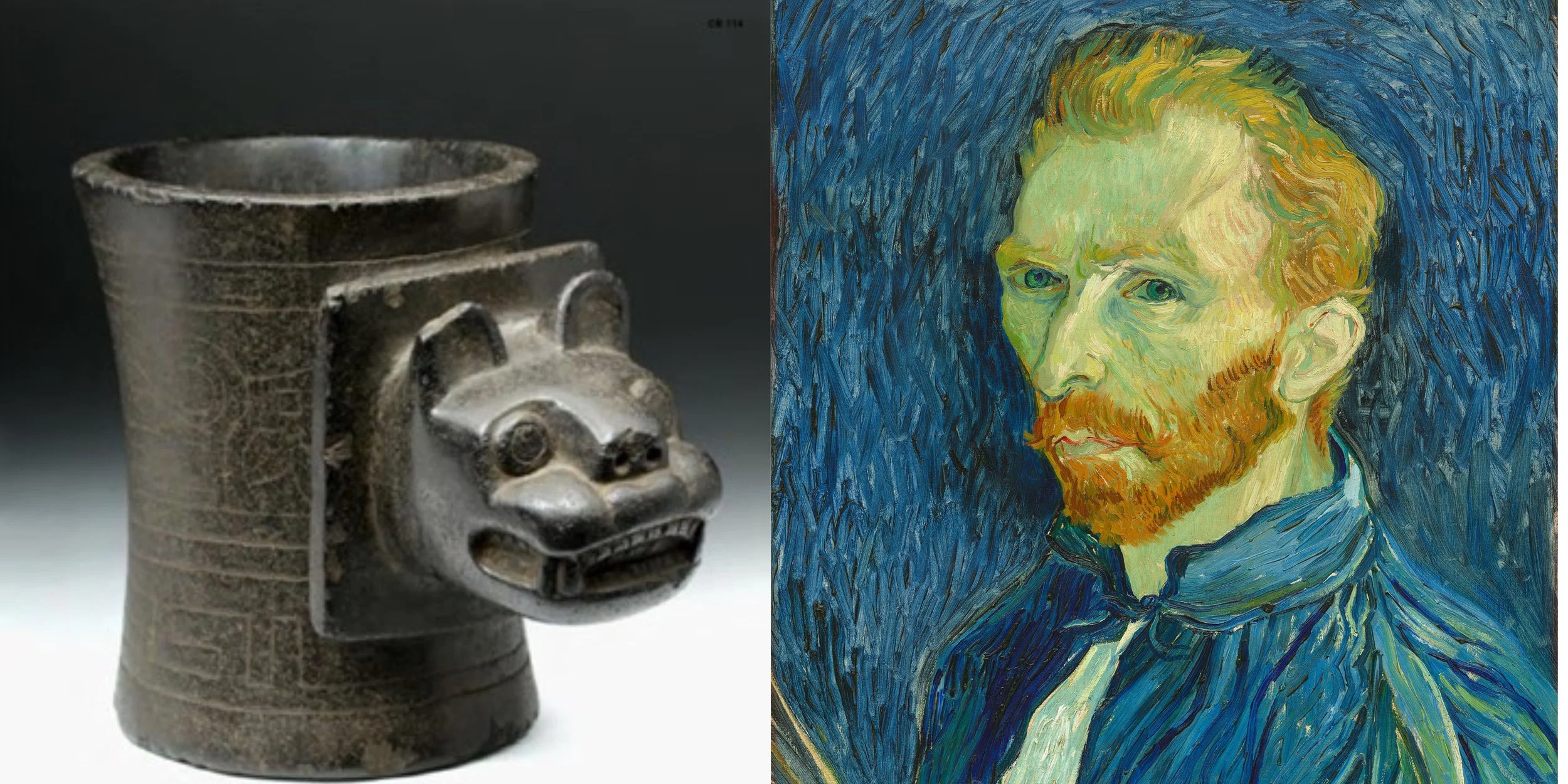
Right: Image of the Bolivian Artefact sourced from Federal Court of Australia. Left: Self-Portrait by Vincent Van Gogh, 1889, image sourced from Canva: National Gallery of Art Images.
Aurelian Lawyers & Advisers is your go-to source for art-related legal cases and law reform in Australia, as well as select cases internationally.
In this story, Principal & Founder Alana Kushnir and Lawyer Sarah Wei report on recent developments in cultural heritage seizures and brand name disputes in Australia, as well as on restitution limits in the US, an EU ruling on the distinction between art and design, and more.
Australia
High Court affirms Government’s broad powers to seize cultural artefacts
A pre-Columbian artefact taken from the ancient Bolivian site of Tiwanaku more than 70 years ago has been forfeited under the Protection of Movable Cultural Heritage Act 1986 (Cth) (‘the Act’).
In September 2025 the High Court of Australia ruled in Palmanova Pty Ltd v Commonwealth of Australia [2025] HCA 35 that Australia’s movable-heritage laws can apply even when an object was illegally exported decades before the legislation came into force. The Act was enacted to support international cooperation in safeguarding cultural property and to enable Australia to comply with its obligations under the 1970 UNESCO Convention on the Means of Prohibiting and Preventing the Illicit Import, Export and Transfer of Ownership of Cultural Property (‘the Convention’).
The case concerned section 14 of the Act, which renders a “protected object of a foreign country” liable to forfeiture where its export from that country was prohibited by law and the object is subsequently imported into Australia. The Justices noted that article 15 of the Convention permits broader bilateral or multilateral arrangements for restitution irrespective of the date of export, reinforcing an interpretation of the Act that prioritises international cooperation and the return of cultural objects. Crucially, their Honors found article 7(b)(ii) of the Convention contains no limitation tied to the date of export from the source country; instead, the only temporal focus is on the date of import into the requested State.
In this instance, black basalt artefact was bought online by Palmanova Pty Ltd in 2020 from a gallery in Colorado, shipped to Australia via Fedex and intercepted by Australian customs on arrival in Melbourne. Evidence suggested it had been removed from Bolivia many years earlier in breach of long-standing export restrictions.
The Justices also referred to the Act’s Second Reading Speech, which described the purpose of the Act as being "to protect Australia's heritage of cultural objects and to extend certain forms of protection to the cultural heritage of other nations".
The Court held that the decisive factor is the unlawful export under the foreign country’s law, not the timing of that export.
Read the full judgement here.
The difference between misleading conduct and trade mark infringement
A major Australian homewares retailer has succeeded in their appeal to the High Court against a competitor for misleading and deceptive conduct.
In Bed Bath ‘N’ Table Pty Ltd v Global Retail Brands Australia Pty Ltd [2025] HCA 50, the High Court of Australia ruled that the use of the name “House Bed & Bath” by Global Retail Brands Australia (‘GRBA’) amounted to misleading or deceptive conduct under the Australian Consumer Law (‘ACL’).
The dispute arose from GRBA’s launch of a soft homewares business under the “House Bed & Bath” banner. Bed Bath ‘N’ Table, a well-established retailer in the soft homewares market since the 1970s, argued that GRBA’s use of the similar wording would mislead consumers into believing there was an association between the two brands.
Misleading or deceptive conduct under section 18 of the ACL does not require proof of intention to mislead. The test is objective: whether the mark would be likely to mislead or deceive the ordinary and reasonable consumer. In Australian Woollen Mills v F S Walton & Co Ltd, Dixon and McTiernan JJ explained that liability arises where conduct conveys to the public a representation that is false in a material respect. The focus is not on intention but on the effect of the representation on the audience, which was relied on as authority for the following decision.
In the present case, the presiding judges also considered that the respondent sought to leverage the brands the unique association of the word pairing “bed” and “bath”, despite awareness of the risk of consumer confusion. They found that where words are descriptive, liability may still arise if their use, in context, conveys a false or misleading representation including, and most notably, a suggestion of affiliation, collaboration, or sponsorship in said brand.
Furthermore, the Justices noted that consumer law focuses on real-world market context including an established brand’s reputation, which in this case had been established over 40 years, rather than a narrow, side-by-side comparison of trade marks.
Read more here.
Small business write-offs and tax breaks extended
The Federal government has extended the $20,000 instant asset write-off until 30 June 2026, allowing further support for small businesses, including commercial galleries, auction houses and dealers. The discretionary measure allows entities with an aggregated turnover of less than $10 million to immediately deduct the full cost of assets purchased and ready for use within the same financial year.
In simple terms, if a business purchases a work for less than $20,000 in value, it can claim the whole amount as a tax deduction in the same year, without having to spread costs out over multiple years or periods and thereby offsetting how much tax the business pays in a single financial year.
Find out more here.
International
Restitution limits under the HEAR Act
In the United States, the decision in Schoeps v Sompo Holdings, Inc, No. 25-1405 (7th Cir. 2025)upheld the dismissal of a restitution claim by heirs of a Jewish collector seeking recovery of Van Gogh’s Sunflowers, who allegedly sold the work under duress during the Nazi era. Although the claim relied on the Holocaust Expropriated Art Recovery (HEAR) Act of 2016 (United States) (‘HEAR Act’), the court found it lacked jurisdiction.
The painting had been purchased at a 1987 Christie’s auction by a predecessor of Sompo Japan and was later briefly exhibited at the Art Institute of Chicago in 2001–2002. The plaintiffs had argued that the painting’s brief exhibition in Chicago and the presence of a Sompo subsidiary in Illinois established a sufficient connection for a lawsuit in the United States. The Court rejected this argument, characterising the Chicago exhibition as a mere “happenstance” insufficient to establish personal jurisdiction.
It held that the defendants’ limited contacts with Illinois, including the temporary loan of the artwork and the activities of a corporate affiliate, were unrelated to the underlying ownership dispute.
Importantly, the Court clarified the scope of the HEAR Act. While the Act pre-empts statutes of limitation and allows claims for Nazi-era art losses to be brought within six years of actual discovery, it does not create an independent cause of action. The Court emphasised that under Section 5 “nothing in this Act shall be construed to create a civil claim or cause of action”, confirming that claimants must still rely on existing state or common law causes of action and satisfy jurisdictional thresholds. Accordingly, the assertion of specific personal jurisdiction would fail the country’s constitutional requirement of minimum contacts, as there was no adequate nexus between the defendant’s forum and the plaintiffs’ claims.
The decision affirmed that the HEAR Act removes time barriers for claims but does not bypass the fundamental requirements of due process and jurisdictional nexus.
Read the full judgement here.
US Supreme Court decides that Trump’s authority to impose global tariffs is beyond his executive powers
In a major ruling on the limits of executive power, the U.S. Supreme Court has struck down the sweeping tariffs imposed by the President under the International Emergency Economic Powers Act (‘IEEPA’). In a 6-3 decision released on 20 February 2026, the Court held that the IEEPA does not grant the President the unilateral authority to impose revenue-raising tariffs.
The tariffs, which were first introduced in early 2025 on goods from China, Canada, and Mexico, had been expanded to cover most U.S. trading partners. The government argued that the IEEPA’s power to "regulate importation" included the power to set tariffs during a declared national emergency. The Supreme Court rejected this, stating that the tariffs imposed are a form of taxation, and the power to levy taxes and duties remains a core congressional authority under Article I of the Constitution.
The decision marks a significant reaffirmation of the constitutional separation of powers in the trade and tax context. It also raises immediate questions about the validity of tariffs already collected and the extent to which further congressional authorisation will be required to maintain or replace them, yet to be decided on. As of writing, it is widely reported that President Trump attacked the ruling and said he was “ashamed” of some justices. He announced plans to continue tariffs using alternative legal authorities, including new global tariffs under other trade statutes.
Read the full judgement here, and a detailed summary of the findings here, and opinions on how it will affect the art world here.
Tesla’s “Blade Runner” dispute moves forward
A US federal judge in Alcon Entertainment LLC v Tesla Inc (No 2:24-cv-09033) for the Central District of California (Los Angeles) has refused to dismiss a copyright infringement lawsuit against Tesla and Elon Musk over alleged unauthorised use of imagery inspired by Blade Runner 2049 used by his company.
Alcon Entertainment, producer of the film Blade Runner 2049, claims Tesla used an orange-tinted dystopian cityscape image resembling scenes from the movie to promote its cybercab after being denied a licence. Alcon alleges Tesla generated the image using AI tools based directly on visual prompts referencing the film.
The judge held that Alcon presented a plausible copyright infringement claim sufficient to proceed to trial. To succeed, Alcon must now show:
(1) ownership of a valid copyright; and
(2) copying of original elements of the work.
The case is still active and moving onto the next stages of litigation, and no trial date yet set publicly.
Importantly, the Court acknowledged that in the age of AI, infringement claims may extend beyond end product works to include copying that occurs during the creation process.
Find out more details here, and stay tuned with us as the case develops.
Where does originality lie? The line between design, art and copyright
On 4 December 2025, the Court of Justice of the European Union clarified the long-running debate over the boundary between design and art in the case of Mio AB, Mio e-handel AB, Mio Försäljning AB v Galleri Mikael & Thomas Asplund Aktiebolag (Case C-580/23) and USM U. Schärer Söhne AG v konektra GmbH, LN (C‑795/23). The Court affirmed that applied art is not subject to a higher originality threshold than other artistic works. There is no “rule and exception” structure between design law and copyright law that would justify stricter requirements for functional objects.
At the same time, the Court made clear that novelty and individual character (relevant under design law) are distinct from originality (the test under copyright law). The existence of registered design protection does not necessarily mean that the originality requirement has been fulfilled, such that copyright subsists.
Importantly, the Court acknowledged that applied art is often shaped by technical, ergonomic or industry constraints. However, copyright can still arise where the author’s personality is expressed through free and creative choices that are visible in the final object.
For infringement claims, national courts must identify the original creative elements of the work and assess whether those elements have been reproduced in a recognisable way.
As a preliminary ruling under Article 267 of the Treaty on the Functioning of the European Union, decisions by the CJEU binds the referring national court as well as other EU member states giving them authoritative interpretation of the issues to follow.
Read more here.
Modigliani and contracting around authenticity risk
A new lawsuit in New York shines light on the “Modigliani forgery epidemic.” Collector Charles C. Cahn Jr. has filed suit against Sotheby’s (Cahn v. Sotheby’s, N.Y. Sup. Ct., Nov 2025) alleging the auction house breached a settlement agreement involving a 1917 Modigliani painting, Portrait of Leopold Zborowski, that he bought in 2003.
Read more here.